
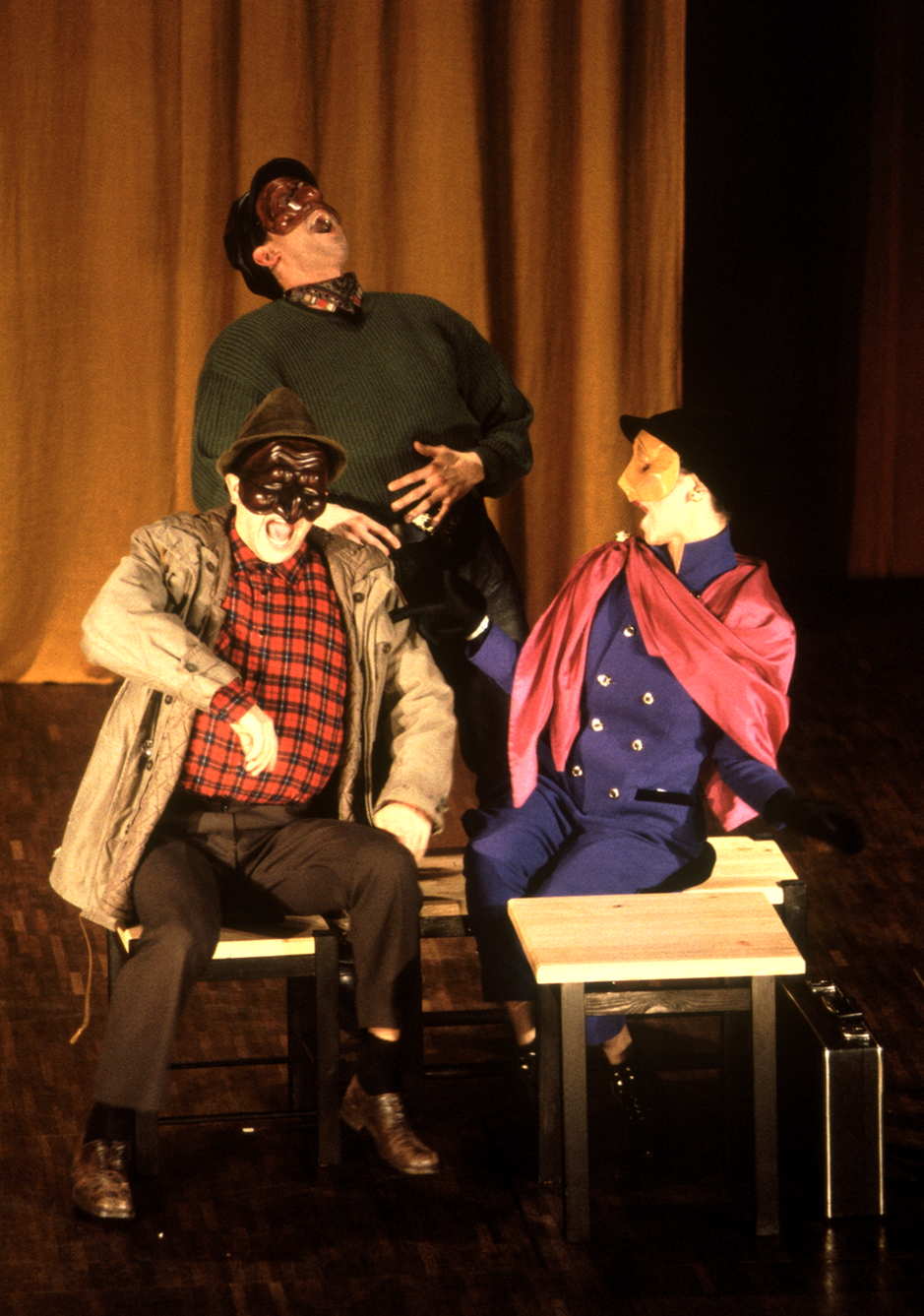
Speech is Silver…
Book & Direction: J.U. Lensing · Dramaturgy: Dr. Andreas Bossmann
Year & Context
1994 · Revised 1998
Co-production with Bauhaus Dessau
Venue
Theaterhaus Düsseldorf
Bauhaus Dessau
Format
Mask Theatre
Commedia dell’Arte / Theatre, Dance, Music
About the Production
“Speech is Silver… is a comedy about our time, exposing, funny, in parts brilliantly performed – a successful mix of theatre, dance and music, fluid behind rigid masks.”
– Erik Felske, Rheinische Post
Speech is Silver… – the title sounds proverbial. For this piece, however, it does not apply. What the Theater der Klänge developed in 1993/94 through collective authorship of the entire ensemble is a political work that brings the social conditions of contemporary Germany directly onto the stage: unemployment, the experience of migration, the everyday failure of communication as a social given. The year was 1993 – the asylum law debate, Solingen, the question of how this country treats those who are not from here. The ensemble decided: this belongs on stage. It still does.
The form was clear: Commedia dell’Arte, the improvisational tradition of Italian popular theatre from the 16th and 17th centuries, with its fixed character masks and physically expressive performance style. The masks – created by Nathalie Cohen and Erhard Stiefel (the mask-maker of the Théâtre du Soleil) – demand physical presence where facial expression is absent. They exaggerate. They expose. Pulcinella becomes Jupp, a Rhineland warehouse worker, 56, just made redundant, helpless at the job centre, looking for someone to blame. Harlequin’s name is Raadji – Turkish background, raised in Germany, with an accent in both languages, at home in neither. The Capitano is an entrepreneur and carries a briefcase. The old types are still with us; you just have to look.
In 25 scenes, 13 characters collide – eight performers switching roles, some multiple times. Each encounter fails in its own way: through language, background, arrogance, plain indifference. Not because people are malicious, but because they cannot or will not listen. The piece deliberately does not begin on stage: Mother Fatma enters the audience, speaks with spectators about her son Raadji before moving onto the stage. The boundary between theatre and reality remains blurred. It is meant to.
The production was created as the final part of the trilogy “Theater der Klänge and Bauhaus” – in co-production with the Bauhaus Dessau – and was performed 19 times across five cities in 1994. For the retrospective marking the company’s tenth anniversary, the piece was revised, condensed, and re-staged in 1998. What was already current in 1993 remained so.
Funded by: Bauhaus Dessau, City of Düsseldorf, State of NRW / Cultural Affairs Department, Stiftung van Meeteren
Credits
Book
Ensemble / J.U. Lensing
Direction
J.U. Lensing
Dramaturgy
Dr. Andreas Bossmann
Set Design
Zarah Ritz-Rahman
Costumes
Caterina di Fiore
Masks
N. Cohen · E. Stiefel · J.U. Lensing
Music
J.U. Lensing · Thomas Wansing
Lighting
J.U. Lensing · Sascha Hardt
Cast
Jacqueline Fischer
Mother Fatma
Kerstin Hörner
Silvia / Frau von Berg
Maria-Jesus Lorrio
Dolores
Ismini Sofou
Charalambos
Kai Bettermann
Uwe / Herr Kapitan
Clemente Fernandez
Raadji / Toni
Heiko Seidel
Jupp / Ali / Opa
Thomas Wansing
Mikel
Production Management: Monic Wollschläger
Photography: Sascha Hardt · Andreas Bossmann
Speech is Silver – Press Reviews
→ To the Press Archive
Speech is Silver – Audio
→ Listen on SoundCloud